
Dispensary
Case Study: How Digital Signage is Being Used Around the World
Who is adopting screens, why it matters, and where benefits are biggest. Digital signage is now a core communication and engagement tool for businesses, transit systems, hospitals, schools, and more.

Digital signage isn’t just a flashy trend. It’s now a core communications and engagement tool for businesses, transit systems, hospitals, schools, and more. As adoption accelerates across multiple regions, platforms like Skoop are expanding globally to support businesses deploying screens across different countries and languages.
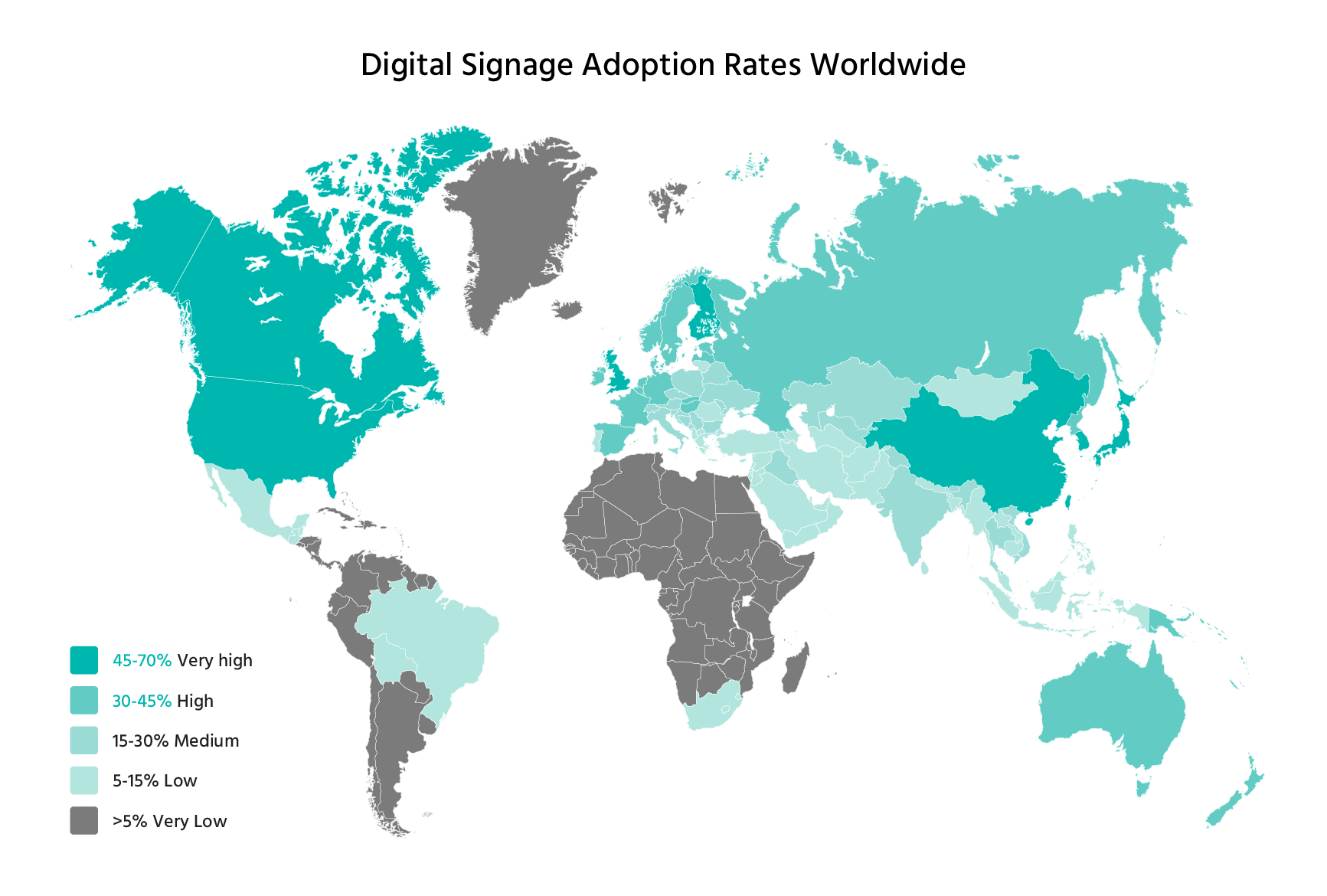
Tier 1: Very High Adoption
Est. 45–70% of large establishments
Typical conditions: High income (GDP per capita > $45k), dense retail and transport networks
Countries: United States, Canada, United Kingdom, Japan, South Korea, Singapore, UAE
In these markets digital signage is widespread in:
- Retail and malls — screens used for promotions and wayfinding dominate the landscape. Retailers in North America report that signage can increase average purchase volume by around 30% after installation and drive brand awareness for 84% of stores that use it.
- Transportation — more than 80% of airports globally use digital screens for flight information and wayfinding.
- Quick‑service restaurants (QSRs) — in the U.S. and Canada, digital menu boards are now standard, with some estimates showing over 90% of QSRs using them.
Benefits seen here:
- Retailers see 200–400% ROI within 12 months in many cases, with 45% recouping costs in under 6 months.
- Airports and transit hubs reduce traveler confusion by up to 65% with digital wayfinding.
- QSRs boost upselling by 15–20% using dynamic menu boards.
Tier 2: High Adoption
Est. 30–45% of establishments
Typical conditions: GDP ~$30k–$45k, advanced urban retail
Countries: Germany, France, Netherlands, Australia, Sweden, Italy, Spain
In these markets digital signage is commonly used in:
- Retail stores and shopping centers
- Public transit hubs and city wayfinding
- Hospitality and dining chains
Example: The Netherlands has about 18% of stores using digital signage, and that number is rapidly growing as retailers modernize.
Benefits here:
- Digital signage cuts communication costs by up to 60% versus print.
- Retailers using screens report improved customer engagement and brand recall, with 80% saying digital signage impacted buying decisions.
- Education and corporate users report up to 20–27% improvements in engagement when screens are used internally.
Tier 3: Medium Adoption
Est. 15–30% of establishments
Typical conditions: GDP ~$10k–$30k, expanding urban retail and malls
Countries: China, Mexico, Brazil, Turkey, Malaysia, Thailand, Poland
China shows a classic pattern of staged adoption: more than 66% of large malls use digital signage, even though smaller stores are less penetrated.
Common uses:
- Retail promotions and product information
- Transit display systems in metros and bus stations
- QSR menu boards and self‑service kiosks
Benefits here:
- Retailers in growing markets see significant foot traffic and sales increases with digital screens.
- Transportation digital boards reduce perceived wait times and improve passenger satisfaction.
- Stores using digital content capture attention up to 400% more than static signage.
Tier 4: Early Adoption
Est. 5–15%
Typical conditions: GDP ~$4k–$10k, emerging modern retail
Countries: India, Indonesia, Vietnam, Philippines, South Africa
In these markets screens are increasingly used in:
- Shopping malls and larger retail stores
- Public info systems, especially in urban and smart‑city zones
- Hotels and hospitality venues
Benefits being reported include:
- Increased engagement and real‑time communication capabilities in malls and public spaces.
- QSR and restaurant digital menus helping drive higher sales and order accuracy.
- Screens enabling modern branding and guest communication in hospitality.
Tier 5: Minimal Adoption
Under 5%
Typical conditions: GDP < $4k, retail mostly small independent shops
Regions: Parts of Sub‑Saharan Africa, South Asia, and Central America
Digital signage here is usually found in:
- Airports and telecom stores
- Government buildings and event venues
Even in minimal markets, screens deliver value:
- Traveler info and advertising opportunities in airports.
- Government and public sector messaging projects are increasing.
The Importance of Global-Ready Digital Signage Platforms
As adoption spreads across North America, Europe, Asia, and the Middle East, businesses increasingly need signage platforms that work across borders.
That includes support for:
- multiple languages
- international content management
- distributed teams managing screens across regions
To support this shift, Skoop is expanding its platform globally. The software is now available to businesses across Europe, Asia, North America, and the Middle East, with built-in multilingual support.
Currently Skoop can be used in:
- English
- Spanish
- Arabic
- Romanian
- German
Additional languages are being added as the platform continues expanding internationally.
Industry Use Cases and Measurable Benefits
Retail
Retail remains the largest use of digital signage worldwide, often accounting for 30–40% of total deployments.
Benefits include:
- Average sales increases of ~30% after installation.
- Higher foot traffic and purchase influence with dynamic content.
- Retailers report up to 200–400% ROI within 12 months.
Transportation
Airports, train stations, and bus terminals use screens for real‑time schedules and advertising.
- 92% coverage of passenger traffic in airports globally
- Reduced perceived wait times and better traveler experience reported in many hubs
Quick Service Restaurants (QSRs)
QSR digital menu boards help with upsells, order speed, and accuracy.
- Leading operators report 15–20% more upselling with dynamic boards.
- QSR digital signage revenue segment is growing rapidly worldwide.
Healthcare
Hospitals and clinics use screens for wayfinding, patient info, and queue updates.
- Over 60% of healthcare facilities deploy digital signage.
- Digital boards can reduce perceived wait times by up to 35%.
Hospitality
Hotels, resorts, and dining venues use digital signage for guest info and promotions.
- Many facilities see increased engagement and satisfaction after installations.
- ROI in hospitality is often realized within 18 months.
Corporate & Education
Internal communication displays and campus boards help with alerts, events, and engagement.
- Corporate digital signage can increase internal communication effectiveness by 20–27%.
- Educational displays improve event attendance and reduce communication costs.
What This Means for Businesses
Digital signage adoption is accelerating worldwide. What started as a retail tool is now used across transportation, healthcare, hospitality, education, and corporate environments.
For businesses operating in multiple regions, the challenge is no longer whether to use digital signage. It is how to manage screens efficiently across locations, languages, and teams.
That is why platforms like Skoop are expanding globally, supporting businesses across Europe, Asia, North America, and the Middle East while enabling multilingual content management.
Today Skoop supports English, Spanish, Arabic, Romanian, and German, with dozens of additional languages planned as adoption continues to grow worldwide.
The takeaway is simple: digital signage is no longer a regional tool. It is becoming a global communication platform for modern businesses.


