
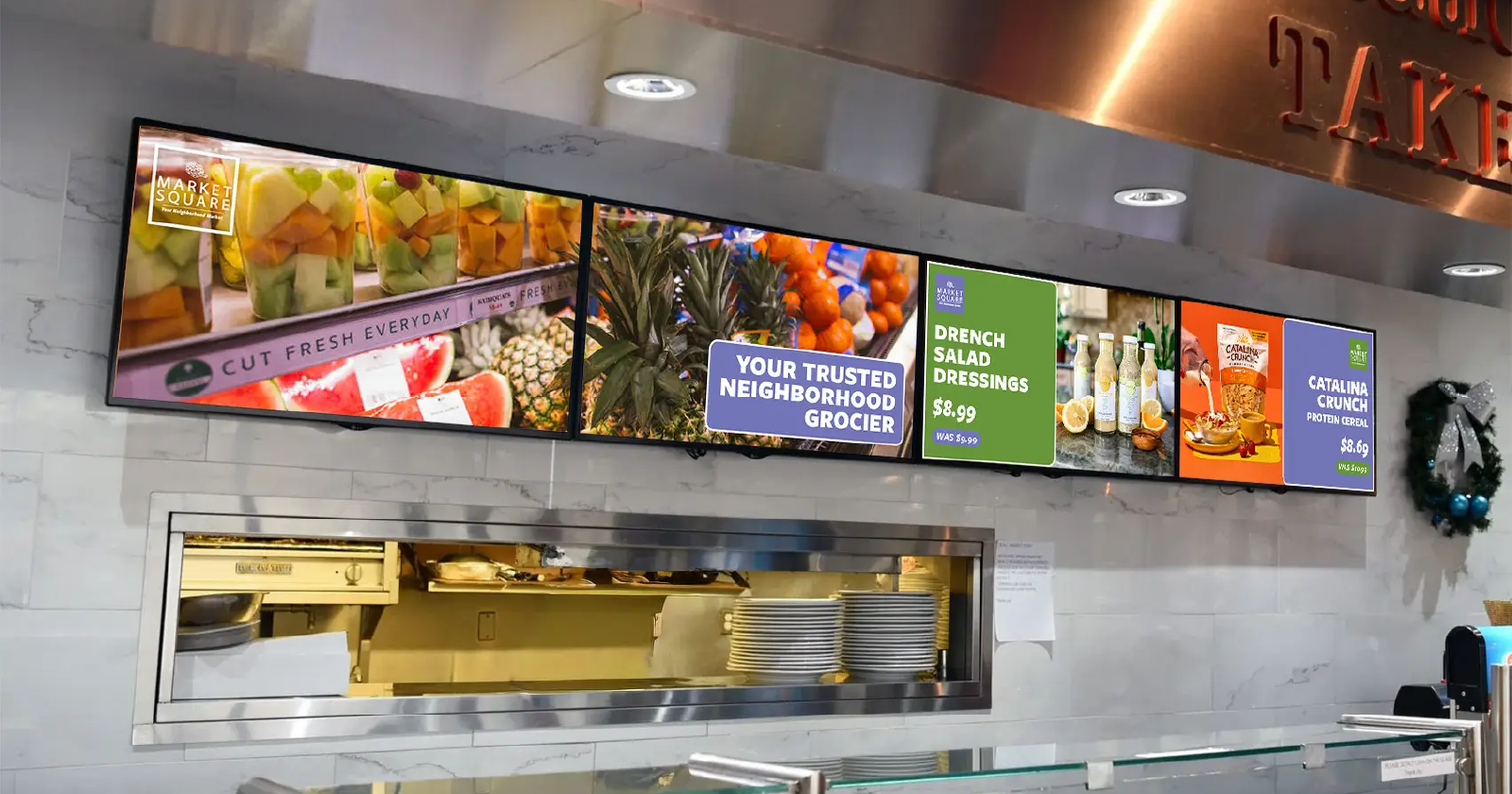
How QSR Operators Are Using Dynamic Signage to Increase Average Ticket Size
Learn how QSR operators use dayparting, animated LTOs, and AI-powered content to increase average ticket size with dynamic digital menu boards.
March 18, 2026
7 min read

The menu board is the most valuable real estate in your restaurant. Every customer looks at it. Most decisions happen there. Yet most QSR operators are still running static images or manually swapping content like it's 2012.
Dynamic digital signage changes that equation. Operators who get it right are seeing measurable lifts in average ticket size — not from aggressive upselling tactics, but from showing the right content at the right time, automatically.
The Problem With Static Menu Boards
Static menu boards don't respond to context. Your breakfast sandwich is still on display at 3pm. Your happy hour deal isn't showing until someone remembers to switch the file. Your LTO launched last Tuesday but half your locations are still running the old board.
That's not a content problem. That's a workflow problem — and it costs you money on every transaction. When customers don't see your high-margin items featured prominently, they don't order them.
Dynamic signage solves this at the platform level, not by adding more work for your staff.
Dayparting: The Fastest Win in QSR Signage
Dayparting means your content automatically changes based on time of day. Breakfast menu from open to 10:30am. Lunch specials kick in at 11. Happy hour pricing appears at 3pm without anyone touching a screen.
This isn't a new concept — but most operators still aren't doing it, or they're doing it manually. With Skoop's content management platform, you set the schedule once and it runs across every screen at every location automatically.
The ticket size impact is direct. When your highest-margin afternoon items — premium drinks, add-ons, desserts — are front and center during the right daypart, attachment rates go up. You're not training staff to upsell harder. The screen is doing the work.
Animated Featured Items Drive Attention (and Orders)
Motion captures attention. A rotating burger with steam rising off the bun performs differently than a flat photo. Customers dwell on animated content longer, and dwell time correlates directly with add-on orders.
"Digital menu boards with animated content have been shown to increase average transaction value by up to 8% compared to static displays — simply by directing attention to higher-margin items at the moment of decision."
The challenge has always been production cost. Getting custom animated content made for every LTO or seasonal item required a design agency, a budget, and a two-week turnaround. By the time the asset was ready, the promotion was half over.
Skoop AI Studio removes that bottleneck entirely. You prompt a complete animated menu experience — featured item, price callout, motion graphics — and it's ready in minutes. No code. No agency. No waiting. What used to cost $10,000 in custom development now takes one prompt.
LTOs That Auto-Activate (and Auto-Expire)
Limited time offers live and die by execution. If your screens don't reflect the LTO on day one, you're leaving money on the table. If they're still showing a sold-out special on day thirty, you're creating friction and disappointed customers.
With scheduled content activation, you set the LTO content to go live at exactly the right time — across all locations simultaneously. You set an expiration. When the promotion ends, the content pulls automatically and your standard menu takes over.
No manager intervention required. No emergency calls to update screens. No location that's still running a ghost promotion two weeks after it ended.
For operators running ten, fifty, or hundreds of locations, this kind of centralized control isn't a nice-to-have. It's how you maintain brand consistency and promotion integrity at scale. Skoop's screen management tools give you that control from a single dashboard.
POS Integration: Signage That Responds to Your Actual Menu
Most signage platforms treat your menu as a design file. You upload images, arrange them, publish. When a price changes or an item gets 86'd, someone has to go back in, edit the file, and republish.
POS-connected signage is different. When your menu data lives in the signage platform, changes flow automatically. Price update in your POS? It reflects on screen. Item sold out? It can be flagged or removed without staff intervention.
This matters for average ticket size because accuracy builds trust. When customers see a price on the board that matches what they pay at the register, there's no hesitation. Hesitation kills add-on orders. Smooth, accurate menus keep the transaction moving — and customers more likely to say yes to the premium option.
How AI Studio Changes the Content Game for QSR
The biggest barrier to dynamic signage has never been the screens. It's been the content. Operators don't have in-house design teams. Agency work is slow and expensive. Templates get stale.
Skoop AI Studio is built for exactly this problem. It's the only digital signage platform with a fully integrated generative AI studio. You describe what you want — "animated lunch special featuring our brisket sandwich with a limited time badge and a warm, rustic color palette" — and the studio builds it.
This means you can create fresh content for every daypart, every LTO, every seasonal push without a production bottleneck. Your screens stay current. Current content performs better. Better performing content means higher ticket sizes.
It also means smaller operators get access to content quality that used to require an enterprise budget. A ten-location regional chain can run the same quality of animated menu content as a national brand.
Hardware Flexibility Matters More Than You Think
Switching signage platforms shouldn't mean ripping out your screens. Skoop runs natively on Samsung, LG, Sony, TCL, and all SOC displays — no proprietary hardware required. If you already have screens in your locations, you can likely get Skoop running on them today.
For new installs, Skoop is the official software partner for the Amazon Signage Stick — an affordable, reliable way to power any HDMI display. This keeps your hardware costs low and your deployment simple.
Lower deployment cost means faster ROI. If you're not paying for proprietary players or expensive proprietary hardware, your investment in dynamic signage pays back faster — especially when the content is actively driving ticket size up on every transaction.
Real-World Impact: What Operators Are Seeing
The operators getting the most out of dynamic signage share a few things in common. They use dayparting religiously. They rotate featured items regularly rather than setting and forgetting. They use motion and animation for their highest-margin products. And they treat the menu board as an active sales tool, not a static display.
The results show up in average ticket size, but also in labor. When content updates are automated, managers aren't spending time on screen maintenance. That time goes back to running the restaurant. The labor savings alone often justify the platform cost — and the ticket lift is incremental upside on top of that.
For QSR operators specifically, where margins are tight and transaction volume is high, even a small lift in average ticket size compounds quickly. A $0.50 increase per transaction across 500 daily transactions is $250 a day. $7,500 a month. $90,000 a year — per location.
What to Look for in a QSR Signage Platform
Not every digital signage platform is built for the pace and complexity of quick service. Here's what actually matters for QSR operators:
Skoop is built to check every one of these boxes. See how pricing works for your footprint at Skoop's
The Bottom Line
Your menu board is already talking to every customer who walks through the door. The only question is whether it's saying the right thing at the right time — or just sitting there.
Dynamic signage with proper dayparting, automated LTO activation, animated featured items, and AI-powered content creation turns your screens from a static display into an active revenue driver. The operators who are winning on average ticket size aren't doing anything magic. They're just showing the right content at the right moment, automatically, on every screen.
That's exactly what Skoop is built to do.
Ready to see how dynamic signage can lift your average ticket size? Book a demo with the Skoop team and we'll show you exactly how it works for QSR operators like you.


